





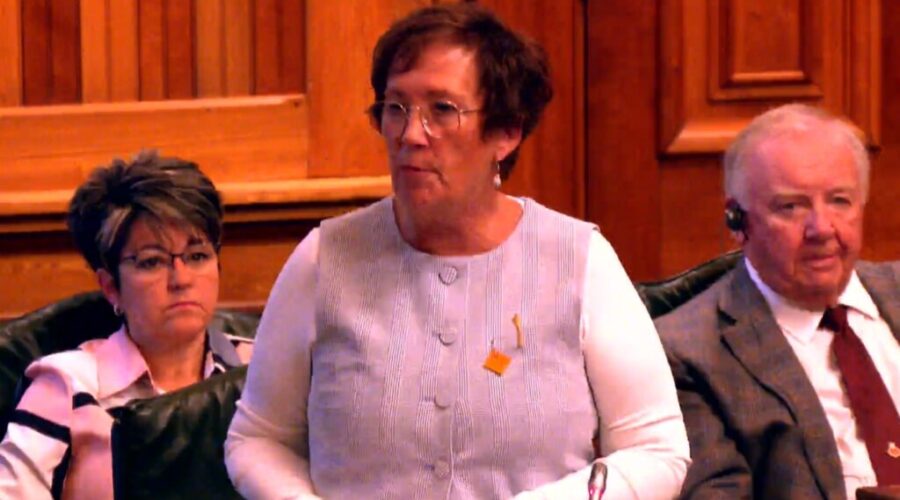
MLAs continue to debate proposed cuts to provincial veterinary services.
The cuts were announced in the Holt government’s budget earlier this year.
An opposition motion was on the floor of the legislature May 14, proposed by Progressive Conservative MLA Tammy Scott-Wallace.
Scott-Wallace said farmers have been asking the Liberal government to reconsider cuts to veterinarians and lab services.
“We are asking government to have a true, sincere conversation with veterinarians, farmers and lab experts to develop a cost-recovery model together to cover what the government says is a $4-million shortfall and stabilize these critical public services for the long haul,” Scott-Wallace said.
She accused Agriculture, Aquaculture and Fisheries Minister Pat Finnigan of disrespecting the people affected by the decision he is supposed to represent.
She also said Finnigan knows how farmers are feeling about the cuts.
“He knows because he stood as a farmer and he fought more than two decades ago to ensure a provincial veterinarian service was available to the hard-working farmers of our province,” Scott-Wallace said.
“How could he have had such a change of heart since that time to the point where his engagement with farmers and vets have felt so insecure that they walked away from his meeting table?”
Scott-Wallace said the Holt government’s decision to eliminate the vet program undermines the goals of a newly established code of practice for the care and handling of beef cattle.
“The code represents a commitment to science and form standards that prioritize animal welfare,” she said.
“However, without the support of the provincial vet program, we risk failing to implement these standards effectively.”
Scott-Wallace said other sectors are facing similar issues without access to adequate veterinary services.
Finnigan said the government understands the change is difficult.
“We remain committed to engaging in an open dialogue with our provincial veterinarians and all industry stakeholders to adopt a sustainable veterinary model for New Brunswick’s agriculture sector,” he said.
Finnigan also said the previous Progressive Conservative government knew the current field veterinary service delivery model was not sustainable.
“They had the number, but they never had the courage to do the right thing and make it a sustainable model,” the minister said.
Carleton-Victoria MLA Margaret Johnson, the agriculture minister under Blaine Higgs, said the debate wasn’t just about line items in the provincial budget.
“It’s about whether this government understands the realities of farming in rural New Brunswick and whether they understand the geography of this province,” Johnson said.
“It’s about whether they understand what happens when a dairy cow is in distress at two o’clock in the morning in Victoria County or when a disease outbreak threatens an entire livestock herd, or when a rural producer cannot access emergency large animal care because there’s simply nobody left to answer the phone.”
Johnson said one troubling aspect of the proposal is how industry stakeholders said they were blindsided and never consulted.
“That is not evidence-based policymaking,” Johnson said. “That is a government announcing a decision first and asking questions later.”
Johnson many of the veterinarians in the provincial service have developed relationships with farmers over the years, know the farms, know the geography and know the risks.
“Once those professionals leave public service or leave the province altogether, that expertise will never return,” she said.
“We have already heard concerns that veterinarians may leave New Brunswick rather than attempt to establish private practices because of the uncertain rural market.”
Johnson said if these vets leave, there is no certainty for small-scale producers.
“Agriculture in New Brunswick is not made up solely of massive industrial operations,” she said. “We’re talking about family farms, mixed farms, goat farms, sheep farms, beef farms, dairy operations, and poultry and equine facilities.
“We’re talking about young farmers trying to establish themselves in rural communities and these operations depend upon access to veterinary care. Not someday, not eventually, not after the market adjusts, they need it now.”
Johnson accused the government of not having any kind of transition plan ready, no recruitment strategy or emergency contingency plans.
“Mr. Speaker, the government argues that the private sector is going to step in,” she said.
“But hope is not a workforce strategy. Announcements are not capacity and ideology does not deliver calves at midnight.”
The motion was ultimately defeated by a vote of 24-16 , with all Progressive Conservative and Green MLAs present voting in favour and all Liberals present voting against.