





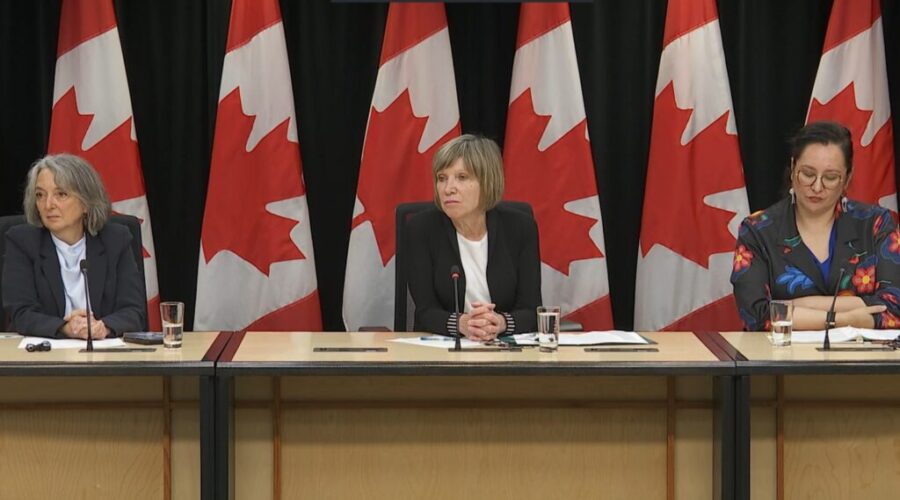
Wildfire season has already begun across Canada, and the federal government is prepared for what could be another difficult summer.
At a briefing Thursday, Emergency Management Minister Eleanor Olszewski said lessons were learned after last year’s season, the second-worst on record.
“We’ve adapted our approach,” she said. “And we’re so much more focused on preparing in advance and co-ordinating closely.”
Olszewski said there have already been 65 recorded fires across Canada, including six classified as out of control.
“We know obviously that hot and dry weather conditions increase the risk,” she said. “And above-normal temperatures are expected across most regions of Canada over the next three months.”
Olszewski said that’s a major concern now, but situations can change quickly.
“That’s why preparedness matters in every jurisdiction and in every community.”
At the federal level, Olszewski said there is a “whole of government” approach.
“Centre of this effort is (the Department of) Public Safety’s government operations centre, which operates 24 hours a day, seven days a week,” Olszewski said.
It’s the first wildfire season for the centre, which opened in November.
“It really helped increase our capacity to respond to disasters and to co-ordinate multiple and complex emergencies concurrently and it will make a real impact this year,” the minister said.
Environment Minister Julie Dabrusin said forecasts for the summer have pointed to a strong El Niño that can create good conditions for wildfires.
“In recent years, wildfires have forced thousands of Canadians from their homes, destroyed infrastructure, disrupted local economies and affected the air quality of millions across the country,” Dabrusin said.
“It’s more important than ever to get prepared and have access to updated information.”
Dabrusin said Environment Canada meteorologists closely monitor conditions both before and during wildfires, and issue air quality warnings when smoke threatens communities.
“We provide detailed forecasts on temperature, precipitation, wind, as well as smoke movement and concentrations, so that Canadians can stay ahead of rapidly changing conditions during wildfire smoke episodes,” she said.
Dabrusin the government can’t just be reactive, though.
“We need to invest in prevention and resilience,” she said.
That includes a new investment of more than $47 million over five years to support wildfire preparedness, response and risk reduction through Parks Canada’s national fire management program.
“This funding will strengthen our readiness by supporting trained wildfire personnel and an increasingly nationally deployable equipment,” Dabrusin said.
She added it will also support measures that reduce wildfire risks, including planned, prescribed fires and vegetation management.
“So far this spring, Parks Canada has conducted 11 prescribed fires treating 1,882 hectares across eight national parks and national historic sites to reduce wildfire risks to communities in and around those areas,” Dabrusin said.
Indigenous Services Minister Mandy Gull-Masty said so far this year, 15 wildfires have affected 15 First Nations.
She said Indigenous Services Canada is working alongside First Nations and provincial partners to support evacuations, preparedness efforts and safe relocations.
Gull-Masty said a good example of the co-operation is the new multilateral emergency management agreement between Abegwit First Nation and the Government of Prince Edward Island.
“For the first time ever in Canada, First Nations are fully integrated into the provincial and federal emergency management system as an equal partner in planning, preparedness, training and decision-making right from the outset,” Gull-Masty said.