





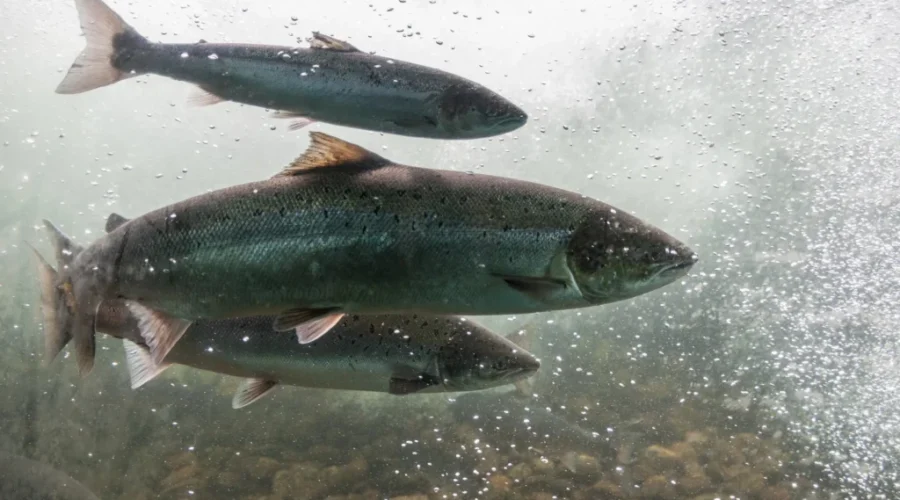
Prime Minister Mark Carney announced the $81.7 million in funding, which would pay out over the following five years, to stabilize and rebuild Atlantic salmon populations.
The news further progresses Canada’s National Strategy to Ensure the Future of Atlantic Salmon, which is part of the Prime Minister’s broader A Force of Nature plan.
The funding – the largest investment in wild Atlantic salmon conservation in Canadian history – triggered an additional $25 million contribution from the Atlantic Salmon Federation (ASF). These funds were raised from foundations and contributions.
The New Brunswick Salmon Council, an affiliate of the ASF, represents 21 organizations across New Brunswick, including one in Maine that shares a drainage with the province.
John Bagnall, Vice President of the N.B. Salmon Council, believes the funding will mean something to their affiliates.
“There’s about $2 million for this year [available for grants], so there’s quite a bit of money for the next four years coming up, and they will be able to apply for funding,” said Bagnall.
The tens of millions will go towards habitat, research and monitoring, improving fish passage at culverts, and making possible collaborations between Indigenous groups and other affiliates.
Bagnall says that although the funding will help groups in the area, he thinks the federal government is missing key priorities.
“The $82 million could, if it was spent right, do a lot. I do not want to be greedy, it could do a lot for salmon, but I think they’re missing priorities,” he said.
The VP sees two issues that should be priorities surrounding the future of Atlantic salmon: striped bass and hatcheries.
“Striped bass are overwhelming the Miramichi River and other rivers in the Gulf region that flow into the Gulf of St. Lawrence. The priority should be to control the striped bass so they’re not predating the smolts as they go out into the high seas and allow returns from the ocean so that we can get rebuilding of the Miramichi salmon stock, and they’re also affecting the Restigouche now,” said Bagnall.
He says controlling striped bass would not require funding and could be done by increasing the number of fish that can be caught annually by First Nation fisheries, which currently sits around 200,000, according to Bagnall.
“Striped bass is a wonderful commercial species and First Nations have the right to catch those fish, they’ve just got to be given the opportunity to get them every year, 300 to 350,000 would be better, so we can get striped bass down to 100,000 which would allow for the rebuilding of the Miramichi salmon stock and would keep the fish from going up into the Restigouche where they’re eating juvenile fish.”
Hatchery support, or smolt-to-adult supplementation, is when wild smolts are grown out of the hatchery (in this case, salmon) into adults and released into the wild, which allows for further spawning in waters. Bagnall says there are ways to do this without creating genetic problems and could rapidly rebuild the stocks as long as bass are controlled.
The Miramichi represents over half of the juvenile production habitat out of all the salmon rivers in the Gulf region. If striped bass are not contained, the salmon population will continue to dwindle and could reach a point of depressed population phenomena, which, according to Bagnall, could result in losing salmon in the entire region.
“It’s getting very serious, and we’d like the Department of Fisheries and Oceans to establish a new reference point way below the 547,000 bass that presently exist, like 50,000 or similar, and have a target of 100,000 spawning bass that is compatible with the sustainability of the Miramichi, and will protect other rivers too,” said Bagnall. “We’re in serious difficulty, and there’s a lot of denial out there.”
He says that fisheries could be curtailed if the number of spawning bass drops below 547,000. The spawn target is currently 730,000 striped bass, which Bagnall believes is unreasonable.
“In 2024, it was a disaster, 5,500 salmon came back to the whole Miramichi. There used to be 80,000 in the past, and there’s been over 100,000. Last year was a little better, 7000 according to my calculations,” said Bagnall. “Trouble is last year, a vast majority were grills, or males. The big game in salmon management is to get egg deposition into the gravel so you can get fry, parr and smolts. Maybe this year there’ll be more multi-sea winter fish, in other words, the big female salmon, hopefully.”
Bagnall says the region is in trouble and needs hatcheries. Groups have an application into DFO to conduct a 4,500 smolt-to-adult supplementation program and are waiting for approval, according to the VP.
“These hatcheries are important tools and [the DFO] doesn’t seem to realize the importance of them,” he said.