





When most people think of Napoleon Bonaparte, they picture the legendary French military leader commanding vast armies across Europe. But few realize that his legacy reaches all the way to Saint John, New Brunswick, Canada. Though Napoleon never set foot here, his influence—and the British response to it—shaped the development of our city in remarkable ways.
During the Napoleonic Wars, Napoleon commanded the strongest land army in Europe. However, his greatest fear was the British Royal Navy, which dominated the seas. In an effort to weaken Britain, Napoleon cut off its access to naval timber from Scandinavia, including Sweden, Norway, and Russia. This was a strategic blow, as timber was essential for building and maintaining warships.
Faced with this blockade, the British Navy turned to Saint John. Our city was strategically located, with a deep, ice-free harbour connected to the Atlantic Ocean via the Saint John/Wolastoq River system—the largest river system east of the Mississippi. The region was rich in timber, and thanks to the Loyalists (exiled American refugees who settled here after the American Revolution), Saint John had skilled shipbuilders ready to meet the demand.
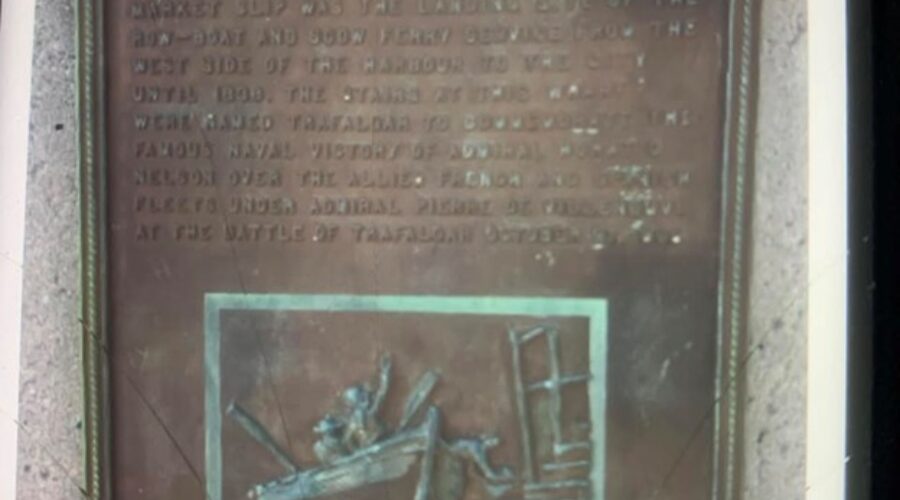
This shift helped establish Saint John as a vital naval and shipbuilding hub. The city’s contribution to British naval strength during the Napoleonic era is commemorated in several local landmarks. The stairs at Ihtoli-maqahamok (Market Slip) are named the Trafalgar Stairs, in honour of the Battle of Trafalgar, where the British Navy defeated the French and Spanish fleets. It was a decisive victory, though it came at the cost of Admiral Lord Nelson’s life.
Saint John’s streets also reflect this history. Waterloo Street and Waterloo Village are named after Napoleon’s final defeat at the Battle of Waterloo in Belgium. The British forces were led by Arthur Wellesley, the Duke of Wellington—whose name lives on in Wellington Row—and were joined by Prussian forces under Gebhard von Blücher.
While Napoleon was feared by monarchs across Europe for threatening their power, he was admired by many for his progressive reforms. He built public schools, improved sanitation with sewer systems, and paid his soldiers well, earning their loyalty. His leadership improved life for many ordinary French citizens, even as his ambitions reshaped the continent.
Saint John’s connection to Napoleon is a fascinating reminder of how global events can influence local history. From shipbuilding to street names, our city played a quiet but crucial role in one of the most dramatic chapters of European history.