




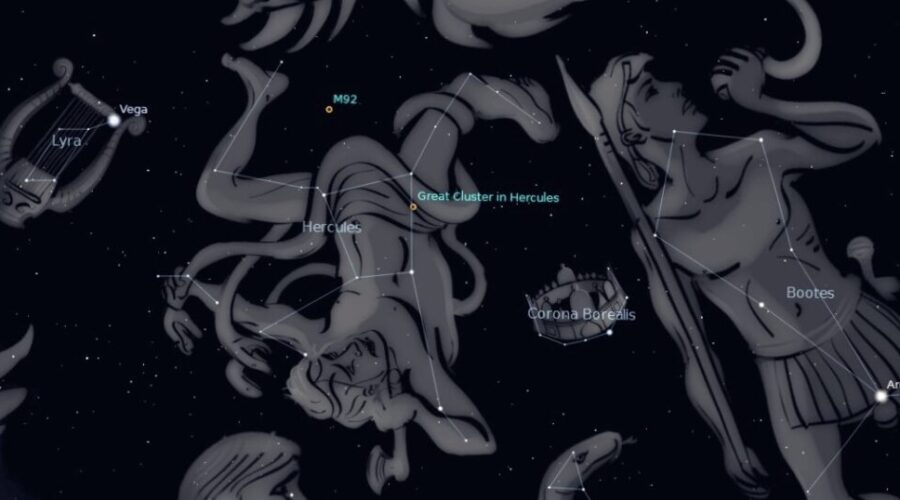
Arcturus and Vega, the fourth and fifth brightest stars of the night sky, are seen high above in evening twilight. I use them to locate the constellation Hercules, which is one third of the way from Vega to Arcturus. Another constellation, the nominal crowning glory of the northern sky, is one third of the way from Arcturus to Vega. Corona Borealis, the Northern Crown, does not stand out among its neighbours or contain any popular telescopic treasures like Hercules does, but its semicircle of stars is pretty to look at. For two years astronomers have been waiting for the Blaze Star, too dim for binoculars, to go nova and briefly become the constellation’s second brightest star.
In mythology, Ariadne was the daughter of King Minos of Crete. She helped Theseus slay the bull-headed Minotaur and escape from the Labyrinth, and then accompanied him and his crew on a voyage home to Athens. Along the way they stopped at the island home of Dionysus, the god of wine. After a night of revelry the crew was made to leave without Ariadne, and Dionysus presented her with a beautiful crown if she would be his bride. The crown was placed in the sky to commemorate their wedding. The constellation also represents a bear’s den in a local aboriginal legend of the bear and seven hunters, which includes stars in the Big Dipper and Boötes.
This Week in the Solar System
Saturday’s sunrise in Saint John is at 5:40 and sunset will occur at 9:03, giving 15 hours, 23 minutes of daylight. Next Saturday the Sun will rise at 5:37 and set at 9:08, giving 15 hours, 31 minutes of daylight.
The Moon is near Antares this Saturday and on Sunday it is full and near apogee, what I call the Puny Moon. Throughout the week it will not climb very high. The highlight of the week will be watching Venus close the gap to Jupiter, with the two brightest planets making an eye-catching pair next weekend. Mercury is well to their lower right, setting around 11 pm by next weekend. On Sunday telescope users might see Jupiter’s moon Europa disappear behind the planet at 10:21, followed by Io 11 minutes later. By 4:30 am this weekend Saturn will be about 13 degrees above the eastern horizon, whereas equally bright Mars will be just a few degrees high,
Tune in to the Sunday Night Astronomy Show at 8 pm on the YouTube channel and Facebook page of Astronomy by the Bay. The Saint John Astronomy Club meets in the Rockwood Park Interpretation Centre on June 6 at 7 pm.
Questions? Contact Curt Nason at nasonc@nbnet.nb.ca.