





The Bank of Canada says Canada’s financial system remains resilient, but new risks are building as global uncertainty grows.
The assessment comes from the Bank’s latest Financial Stability Report, released Thursday.
Households and businesses remain in stable financial condition, and large banks have strengthened their ability to absorb shocks.
However, vulnerabilities have increased in parts of the system, including elevated asset valuations, rising global debt and growing reliance on short‑term funding in sovereign bond markets, according to the report.
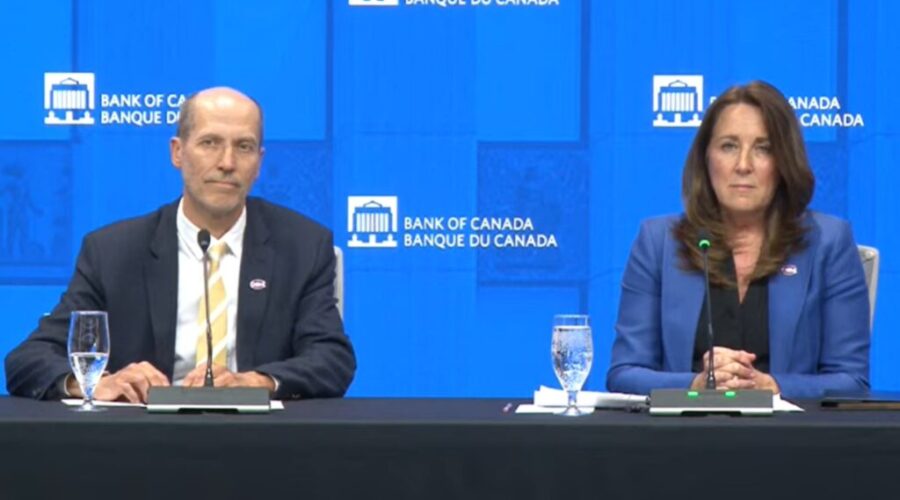
Senior Deputy Governor Carolyn Rogers said hedge fund activity in government bond markets is one area where risk has grown.
“If there’s one area where we see a little bit more risk, it’s in the hedge fund participation in the sovereign bond market,” Rogers said. She said leverage in that sector remains high.
“That makes it more likely that kind of trigger event could happen and disrupt those markets,” she said.
Rogers also pointed to ongoing trade uncertainty with the United States.
“We would see growth would be hurt, unemployment would probably go up,” she said.
The report noted that global shocks have added to volatility.
The war in the Middle East has disrupted shipments of oil and other commodities, pushing up prices and straining some markets.
These developments have created periods of heightened volatility but have not led to broad financial stress.
Households facing pressure, but holding up
Household debt remains high, with the debt‑to‑income ratio sitting just below its 2022 peak, according to the report.
Roughly two and a half per cent of non‑mortgage borrowers and about one and three‑tenths per cent of mortgage holders are behind on payments.
The Bank of Canada said these levels have stabilized over the past year.
Mortgage renewals continue to create pressure.
Many borrowers renewing this year are seeing payments rise by roughly 15 per cent, and about 12 per cent of mortgages still face increases ahead, the report said.
It also noted that most households have managed the adjustment so far, supported by wage gains, savings and the ability to extend amortizations.
Home prices have fallen about five per cent over the past year and roughly 20 per cent from their 2022 peak.
Only about four per cent of borrowers may struggle to refinance, though that number could rise to seven per cent if prices fall further, the report noted.
Banks remain resilient as risks build
Deputy Governor Toni Gravelle said Canada’s major banks are in a stronger position than a year ago.
“Canada’s large banks have become more resilient over the past year with higher profitability and healthy capital buffers,” Gravelle said.
He added that banks have also increased the funds they set aside for potential loan losses.
“This positions them to support the economy and financial system even in a severe downturn,” he said
Banks’ common equity Tier 1 capital ratio sits around 13.7 per cent, and loan‑loss provisions are up roughly 30 per cent compared with three years ago, the report noted.
The Bank’s stress scenario includes unemployment rising toward 10 per cent, home prices falling 25 per cent and oil staying near US$100 a barrel.
Even under those conditions, credit losses would total just over one per cent of loans, according to the analysis.
Business balance sheets remain generally healthy, with loan impairment rates still low, though the report said some firms could face pressure if economic conditions weaken.
Markets stretched as AI, leverage and geopolitical risks grow
Financial markets have grown more vulnerable. Equity risk premiums are near the bottom of their historical range, leaving markets more exposed to a sudden correction.
The Bank said corporate earnings expectations remain high — up 17 per cent for the S&P 500 and 25 per cent for the TSX — and the technology sector now accounts for about 18 per cent of United States investment‑grade bond issuance.
The report highlights risks linked to artificial intelligence.
Rapid adoption could disrupt some sectors and has already contributed to stress in private credit markets.
AI may also increase cyber risks by making software vulnerabilities easier to exploit, and a sharp drop in AI‑related stocks could spill over into broader markets.
Non‑bank financial institutions have increased their use of short‑term borrowing, the report said.
Asset managers now rely on roughly 300 billion dollars in repo leverage, and daily repo market activity exceeds 130 billion dollars.
This borrowing supports liquidity in normal times but could amplify stress if funding conditions deteriorate, the report noted.
It also said that hedge funds buy more than 40 per cent of Canadian government bonds at auction and account for about 25 per cent of trading between dealers and clients.
Their reliance on leverage means a sudden pullback could strain core funding markets.
The Bank said that Canada’s financial system has remained stable through recent shocks, but the risk of several vulnerabilities crystallizing at once has increased.
Officials say they will continue monitoring conditions closely and remain in contact with financial institutions and domestic and international partners.