




Strong support for bilingualism.
That finding, along with others, were identified in a survey from the Office of the Commissioner of Official Languages:
- 81% of respondents support the Official Languages Act
- 89% of respondents are confident that they can receive government services in the official
language of their choice - Some Francophones said that the quality of service they received in a provincial government
office was worse than the service they would have received in the other official language - 92% of respondents felt it was important that instruction in the other official language be
available in New Brunswick schools - 91% of respondents felt that second language training for adults should be available free of
charge in the province - Only 76% of Francophones speak French most often at home, while 99% of Anglophones
speak their mother tongue most often at home - Young Anglophones are more likely to report a good level of bilingualism than their older
counterparts
Sixty per cent of New Brunswickers surveyed felt that the relationship between Anglophone and Francophones is more positive today than it was ten years ago.
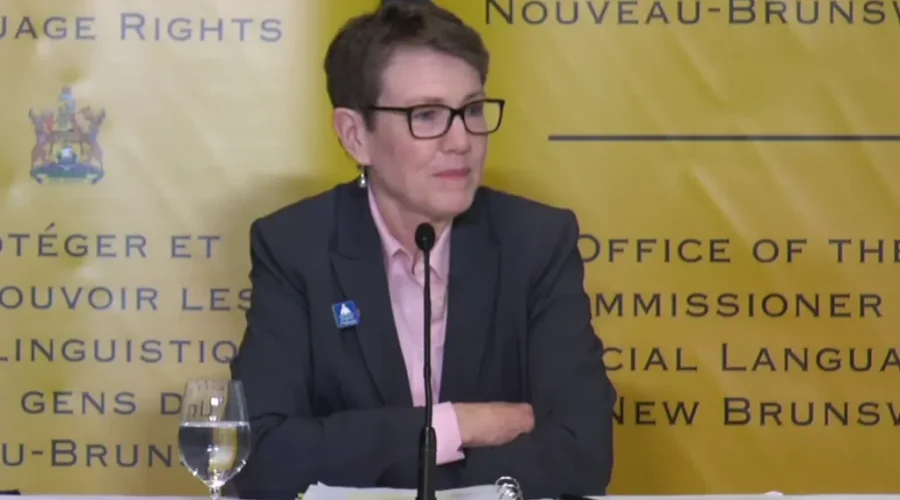
“Among the minority of New Brunswickers who felt the relationship between linguistic communities was not as positive as ten years ago, the top reasons for the breakdown in the relationship include perceived division in the community, as well as unfairness in employment income, or opportunities. To me, this research confirms positive indicators of the success of the Official Languages Act and that New Brunswick bilingualism is valued by most New Brunswickers,” said Commissioner Shirley MacLean.
MacLean admitted there are still many myths surrounding employment, “The Official Languages Act makes it so that New Brunswickers can access government services in the official language of their choice. It does not mandate language learning or dictate that all government employment positions must be filled by bilingual employees. Certainly, in order to provide services in both official languages, a number of positions are designated as bilingual in the province. But, in all corners of the Public Service, hiring managers utilize a team approach which enables Unilingual employees to work alongside bilingual employees to provide public services in accordance with the Official Languages Act.”
She noted that these myths are due to a lack of understanding, “The Government of New Brunswick, I believe, is probably the largest employer in the province. We are the only bilingual province, and there tends to be a belief that you have to be bilingual to have a government job and people do see government advertisements for government jobs and some do have that requirement. But perhaps there isn’t an understanding that not all positions that are advertised have that requirement. So again, it’s a myth that is propagated through lack of understanding and a way of debunking myths is to educate people and to create the understanding to dislodge that myth, and that’s my responsibility.”
The survey also found a low awareness of the Official Languages Act and where to complain if language rights aren’t respected.
MacLean called this disappointing adding, “My office will be re-doubling its efforts to encourage New Brunswickers to exercise their language rights and to raise awareness of the Office of Commissioner of Official Languages and the services we offer.”
An advertising campaign is also being created.