




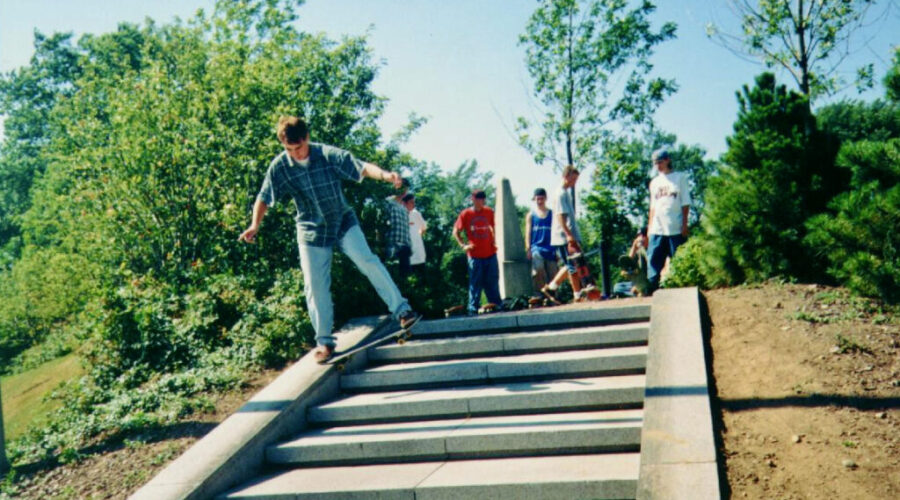
(Photo: Ashley Morgan skateboarding the Loyalist Burial stairs in 1997)
The population ranking needs context. The decades of lost opportunity do not.
By Ashley Morgan
This is Part One of a three-part response to Barry Ogden’s “Third Place Should Be a Wake-Up Call for Saint John.”
Barry Ogden’s commentary resonated with me.
I agree that Saint John needs a wake-up call. But even the population ranking itself isn’t as clear-cut as it sounds, and I think it hides as much as it reveals.
Fredericton’s municipal boundaries expanded in 2023, adding roughly 4,500 residents. At the metropolitan level, the Saint John region remains larger than the Fredericton region, and Saint John itself has returned to population growth, with an estimated population of 78,165 in 2024, its highest level since the early 1980s.
So I don’t think Saint John is a city presently collapsing.
I think it’s a city that spent decades falling behind what it could have been.
That distinction matters because Saint John still has most of the things that should give it a fighting chance.
I grew up in the Saint John area, technically Quispamsis. I attended UNB Saint John, worked at Harbour Station, and moved to North Carolina in 2000 because there were simply better opportunities.
I still return once or twice every year to visit family.
The region raised me. UNBSJ educated me. Saint John employed and entertained me. Then, like a lot of people I grew up with, I built my career and adult life somewhere else.
Maybe that’s partly why I notice the changes every time I return.
The Saint John I remember from the 1980s and 1990s felt different.
Downtown (and yes, I still refuse to call it “Uptown”) was busy and clean, and it felt safe to me. King’s Square had people in it. Brunswick Square and Market Square were busy on weekends.
Does anyone remember Loyalist Days and the parade?
I was just an annoying skateboarding teenager dodging cars on King Street, but it felt as though something was always happening.
I remember the Saint John Flames. I worked at Harbour Station and remember packed events, including Garth Brooks’ three-night run. I even spent a while talking to him backstage, thinking he was just part of the crew because I had no idea who he was.
I remember looking forward to the Exhibition at the end of every summer. And yes, I know a smaller version still comes through, but anyone who remembers what it used to feel like probably knows what I mean.
None of those things determines a city’s economic future by itself. Together, though, they create something harder to measure: energy.
People want to live in places where things happen.
Nostalgia undoubtedly edits out the dull Tuesday afternoons. But nostalgia does not explain everything. Too much of downtown today can feel empty outside cruise calls, waterfront events, and the pockets of activity that local businesses and community organizers work hard to create.
When teams, traditions, employers, events, and institutions disappear, and nothing of similar importance replaces the role they played, a city gradually feels smaller.
To Saint John’s credit, there are examples today of exactly the opposite happening. AREA 506 has become a real waterfront event that attracts thousands of people and gives the city something new to call its own. And thankfully, the Sea Dogs picked up at least some of the hockey energy the Flames left behind.
But Saint John doesn’t need to recreate 1996. It needs more things in 2026 that kids growing up there will remember in 2056.
The harder part of Saint John’s story is the regional math.
Over several decades, families moved to Quispamsis, Rothesay, Grand Bay-Westfield and surrounding communities. They did nothing wrong. They made rational choices about homes, neighbourhoods, taxes and quality of life.
The City itself has acknowledged the problem: as people moved toward surrounding communities and more spread-out parts of Saint John, the tax base became harder to grow, while the cost of providing services rose.
Saint John also has a lot of land inside its own boundaries. Current City planning documents show that 18% of residents live in rural settlement areas, which cover 76% of the city’s land base.
That’s a lot of city to service.
Saint John covers approximately 316 square kilometres. Raleigh, North Carolina, where I now live, covers approximately 381 square kilometres.
The municipal footprints are surprisingly similar.
The populations are nowhere close.
Raleigh’s 2020 census population was 467,665. Saint John’s 2021 census population was 69,895. Saint John has grown since then, but the difference in scale remains enormous.
Both cities maintain roads, emergency services and infrastructure across large areas. Saint John must also clear snow and manage infrastructure exposed to a much harsher climate.
At some point, this stops being a political argument and becomes arithmetic.
That doesn’t automatically make amalgamation the answer.
But Greater Saint John needs an honest discussion about whether regional costs, services and tax revenues are distributed in a way that supports a strong central city.
Then there’s the shipyard closure, which cannot be treated as a historical footnote.
Parliamentary records from that period described a shipyard that had once employed 3,500 to 4,000 people but was down to just 275 workers by early 2000.
Those were skilled, well-paying jobs with benefits. Their wages supported mortgages, retailers, restaurants, contractors, car dealerships and thousands of families.
You don’t remove an economic engine like that from a city Saint John’s size without feeling it everywhere.
The shipyard was hardly the only loss. Good corporate, institutional and public-sector jobs disappeared, moved or were consolidated over the years.
Saint John never created enough new engines of employment to completely replace what disappeared.
Moncton built itself into a regional transportation, commercial and service centre. Fredericton built around government, universities, research and technology.
Meanwhile, Saint John remained heavily dependent on industry as modern industry became more productive without employing anything close to the number of people it once did.
I don’t think there is one villain in this story.
It wasn’t one mayor. It wasn’t one provincial government. It wasn’t one company.
It was accumulation.
A major employer disappears. Families move outside the city. Young people move out of the province. The tax base grows more slowly. Services get harder to fund. Some of the things that make a city fun disappear too.
Do that for 20 or 30 years, and eventually you look around and wonder where everybody went.
That is what makes Saint John so frustrating to me.
It was never doomed by geography.
It has a historic downtown, a natural deep-water harbour, rail access, major employers, beautiful surrounding communities, and a waterfront most cities would love to have.
Saint John had enough assets to win.
It still does.
But before talking about what Saint John can do with those assets today, there is another thing the region lost over those decades.
People.
I’m one of them.