




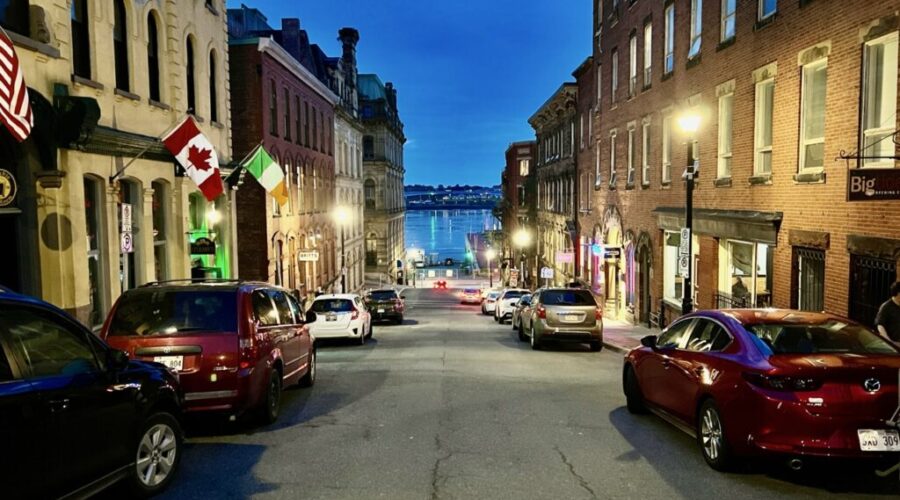
Photo: Princess Street looking towards Saint John Harbour at night
The things Saint John needs to build on are mostly already there.
By Ashley Morgan
This is the final part of a three-part response to Barry Ogden’s “Third Place Should Be a Wake-Up Call for Saint John.”
Read Part One: “Saint John Didn’t Have to Fall This Far Behind“ and Part Two: “The People Saint John Lost.”
If you’ve read the first two articles, thank you. Apparently I had more unresolved feelings about Saint John than I realized.
But I didn’t write three articles to complain about a city I left 26 years ago. I wrote them because I still care about it.
I also want to acknowledge the obvious: I live in North Carolina.
Coming home once or twice a year is not the same as paying property taxes, raising kids, running a local business, or trying to avoid the potholes on Rothesay Avenue in March.
The people who stayed are the ones who built businesses, raised families, paid taxes, coached teams, volunteered, fixed buildings, and kept the place going.
I have a lot of respect for that.
This is not me arriving from Raleigh with the secret plan everyone in Saint John somehow missed.
Living elsewhere has shown me that every city has problems. Raleigh certainly does.
But leaving didn’t make me stop caring about where I’m from, and returning year after year makes some missed opportunities harder to ignore.
The good news is that I see reasons for optimism.
Saint John is growing again, with immigration helping drive that rebound. Housing is being built. AREA 506 has created real energy. Port Saint John has real momentum, and Fundy Quay is finally taking shape.
I am genuinely glad Fundy Quay is happening. That name, though? Yikes.
Saint John needs more people living downtown. They support restaurants and shops, create activity after five o’clock, and add tax revenue without pushing infrastructure farther outward.
But housing is not a complete waterfront strategy.
Take a weekend trip to Halifax. Yes, Halifax is much larger. That isn’t the point.
Walk its waterfront and look at how many reasons people have to be there: restaurants, hotels, museums, performers, festivals, public spaces and people simply enjoying the afternoon.
The lesson isn’t “turn Saint John into Halifax.” It is to treat the waterfront like one of the city’s greatest assets.
Saint John already has the City Market, Market Square, historic architecture, Harbour Passage, cruise traffic and a working harbour.
Give people more reasons to go there in February too.
And while I’m making suggestions that may get me in trouble, I’ll add one more: Saint John should have a casino.
There, I said it.
I mean an entertainment destination with a hotel, restaurants, live entertainment and event space, not a room full of slot machines that magically fixes the city.
Moncton has one. Halifax has had one for decades.
Saint John officials discussed the idea with the province in 2018, so apparently I’m not the first person crazy enough to suggest it.
Problem gambling is a legitimate concern, and any proposal would need to address it seriously. A responsibly planned destination that strengthens tourism and conventions is worth revisiting.
Then there is the part of Saint John’s economy that has always confused me: heavy industry.
Saint John hosts Irving Oil’s refinery, Canada’s largest, capable of processing more than 320,000 barrels a day and employing more than 1,600 people. Add pulp and paper, rail, energy infrastructure, and Port Saint John.
That is extraordinary economic activity for a city this size, yet Saint John has struggled financially for decades.
The heavy-industry math doesn’t seem to be mathing.
That industrial base creates jobs, exports products and attracts investment. Saint John has argued for years that too much of the heavy-industry tax revenue stays with the province rather than with the host community.
The province has now created a framework for a new grant to municipalities that host heavy industry. That is movement in the right direction, although the details will determine how much it actually changes.
The tax details may not be exciting, but the question is simple: if Saint John hosts this much nationally important activity and absorbs the impacts, is enough of that value staying in the city?
That seems like a fair question.
Port Saint John may be the biggest opportunity of all. Container traffic reached another record in 2025, which is great news.
But I am less interested in how many containers pass through the harbour than in what gets built around them: logistics companies, warehouses, marine services, technology companies, manufacturing and repair operations.
How does Saint John turn a successful port into a broader port economy?
UNB Saint John is another enormous opportunity. What happens if the campus grows by several thousand students and builds stronger connections to healthcare, energy, marine industries, logistics and technology?
Then there is Greater Saint John. I grew up in Quispamsis, so I know suggesting amalgamation is a great way to ruin dinner conversation. But the regional economy clearly doesn’t stop at municipal boundaries.
People cross those lines every day to work, shop, eat, attend events and use hospitals.
I don’t pretend to know the perfect structure, but surely Saint John and its neighbours can share some services, costs and revenues more effectively.
And yes, I’d love to stop flying into Bangor.
If Saint John can build reliable, reasonably competitive air connections, people like me will use them.
Better connectivity helps business and tourism while keeping former residents connected to home.
Finally, Saint John needs more things people genuinely look forward to.
What will kids growing up there today remember 30 years from now?
People take care of places they’re proud of. They open businesses, invite friends to visit, and defend the city when someone from Moncton says something irritating.
Most importantly, they stay.
Maybe that’s what I’m hoping comes back more than anything: some swagger. Not arrogance. Just the sense that Saint John knows what it has and isn’t embarrassed to expect more from itself.
I cannot do much about Saint John’s future from North Carolina.
But I can come home. I can spend money there. I can care.
The real work belongs to the people who live there.
I hope Saint John’s next chapter is about what it builds, not just what it lost.
The shipyard is gone. A lot of jobs left. A lot of people left. Saint John fell behind Moncton and Fredericton.
All true.
But none of that has to decide what happens next.
The population is growing again. The port is growing. People are investing. The waterfront is changing. New traditions are being created.
The ingredients that made Saint John important are still there: a natural harbour, a growing international port, Canada’s largest refinery, a university, rail access, an incredible historic core and beautiful communities surrounding it.
Most cities would love to start with that hand.
These articles aren’t about winning an argument over everything Saint John did wrong.
They’re about remembering what made the place special, understanding some of what changed and getting a few people thinking about what comes next.
Saint John didn’t have to fall this far behind.
More importantly, it doesn’t have to stay there.
Barry’s original article said Saint John needs a wake-up call.
I heard it all the way down here in North Carolina.
I hope a few people back home hear it too.