




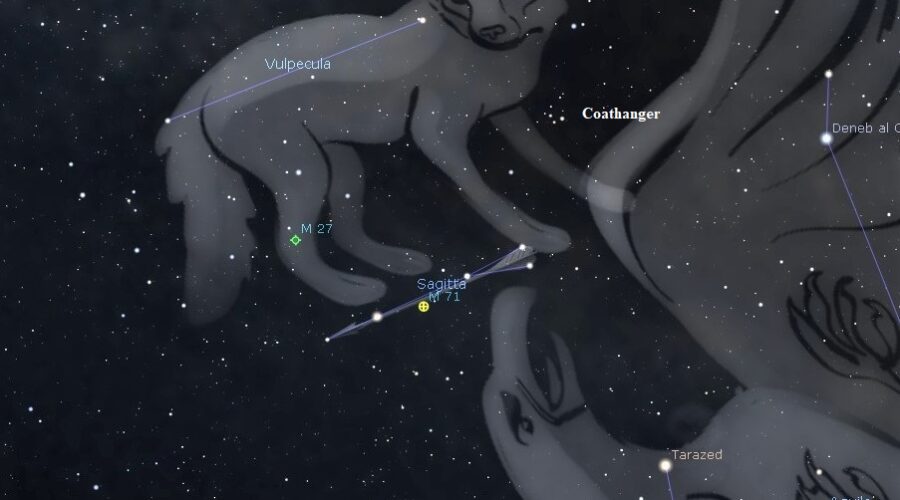
Arrows are used in signs as pointers to direct us to notable sites. As the Summer Triangle of the bright stars Vega, Deneb and Altair rise high in late evening, the tiny constellation of Sagitta the Arrow can direct us to a few interesting binocular objects. Sagitta is a compact arrow situated halfway between Altair and Albireo, which form the heads of Aquila the Eagle and Cygnus the Swan. Albireo itself is an interesting binocular object, being revealed as two colourful stars.
Looking under the shaft of the arrow with binoculars you might notice a hazy patch of stars called M71, which is a globular cluster containing more than 10,000 stars. As globular clusters go it is younger than most and relatively small. Half a binocular field above the arrowhead is ghostly M27, the Dumbbell Nebula. This is a planetary nebula; gases emitted from a Sun-sized star as its nuclear fuel was running out. The star collapsed into a hot, dense, Earth-sized star called a white dwarf, and the ultraviolet radiation emitted from it causes the gases to glow. In older photographs of M27 its bipolar shape resembled a dumbbell. About a binocular width to the upper right of the arrow’s fletching is an asterism called the Coathanger, a favourite treat for closet astronomers.
This Week in the Solar System
Saturday’s sunrise in Saint John is at 5:35 and sunset will occur at 9:12, giving 15 hours, 37 minutes of daylight. Next Saturday the Sun will rise at 5:36 and set at 9:15, giving 15 hours, 39 minutes of daylight.
The Moon is new and at perigee on Sunday, so expect extreme tides early in the week. It clusters with Venus, Jupiter, Mercury, Pollux and Castor on Tuesday evening, pairs with Venus Wednesday and sits above Regulus on Friday. For a challenge, use binoculars or a telescope to watch the crescent Moon occult Venus high in the south-southwest on Wednesday. Venus disappears around 5:15 pm and reappears around 6 pm. Mercury is at greatest elongation from the Sun on Monday, and next Friday Venus is just above the Beehive star cluster in Cancer. On Thursday telescope users might see Jupiter’s moon Europa emerge from the planet’s shadow at 9:40, likely the last evening moon event we can see for several months.
Tune in to the Sunday Night Astronomy Show at 8 pm on the YouTube channel and Facebook page of Astronomy by the Bay.
Questions? Contact Curt Nason at nasonc@nbnet.nb.ca.